
Usage, limits and cost
"API Value" vs What You Pay: Reading Claude Code Cost on a Subscription
How Claude Code turns tokens into a dollar figure, the cost per token behind it, and why that API value isn't your bill on Pro or Max.
On this page
- Where Claude Code's dollar figure comes from
- The per-token prices behind the number
- Worked example: how one session adds up
- What the number means on each plan
- When API value becomes a real charge
- Estimating what an API key would cost you
- Cost per token versus cost per task
- Reading the number across sessions
- FAQ
Claude Code's cost per token is the model's API list price: $4 per million input tokens and $20 per million output tokens on Opus 5.5, $2 and $10 on Sonnet 5.5, with cache reads at $0.20. Claude Code multiplies your session's tokens by those prices to show a dollar figure in /usage and the status line. On an API key that figure is close to your bill. On Pro or Max it's "API value": what the same work would have cost on an API key, while you actually pay the flat $20, $100 or $200 a month.
The prices and behavior below come from the Claude API pricing page, the Claude Code cost docs and claude.com/pricing, checked on October 3, 2026.
Where Claude Code's dollar figure comes from
Claude Code doesn't ask Anthropic what you owe. It counts the tokens in every API response and prices them locally. The costs docs say it "computes the dollar figure locally from token counts at list price," and that the result is an estimate; for authoritative billing, use the Claude Console.
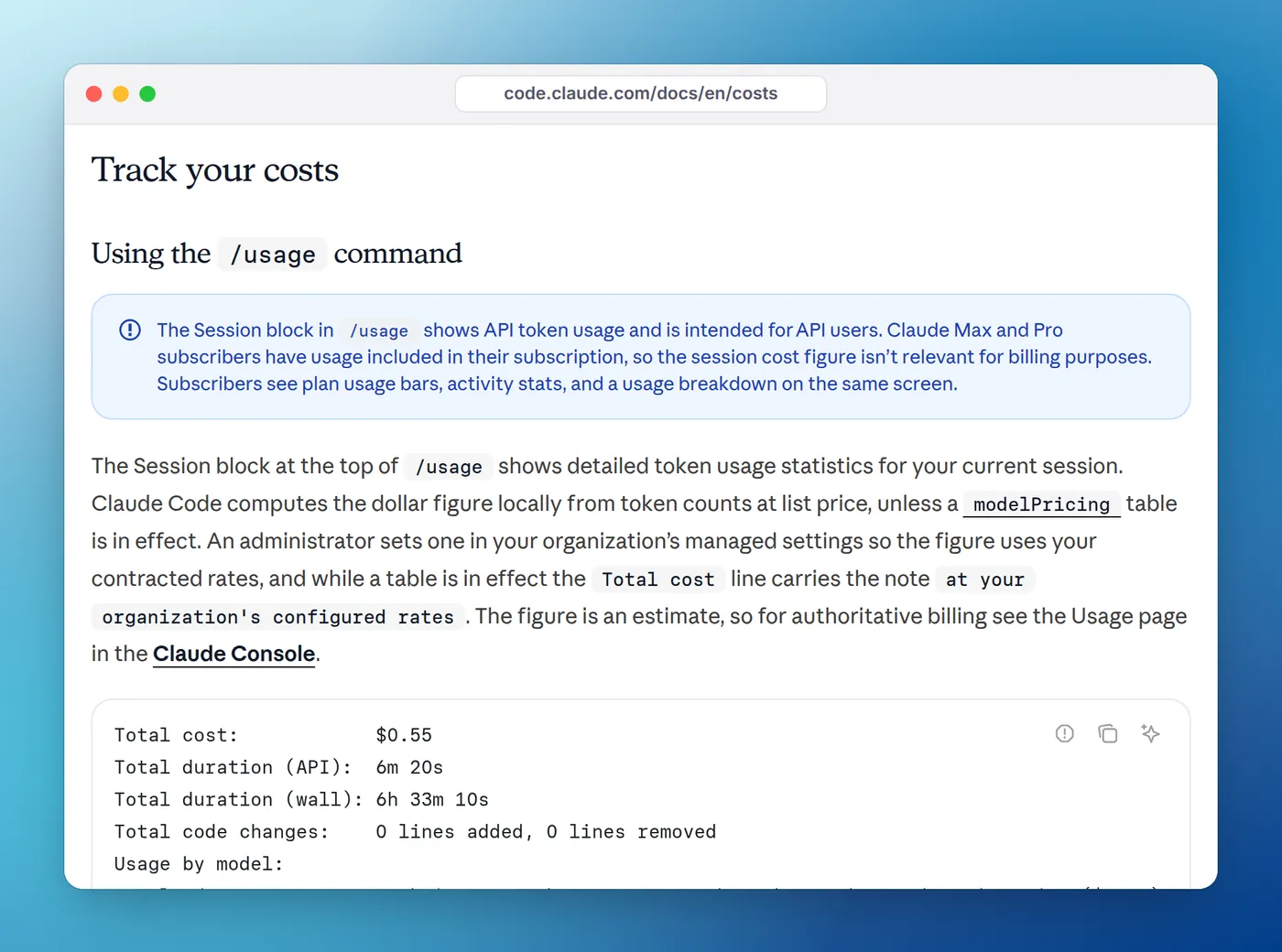
That same number shows up in three places:
- the Session block of
/usage(also opened by/cost), - the
cost.total_cost_usdfield your status line receives, - the
claude_code.cost.usagemetric if you export OpenTelemetry.
Two details change it. If your organization sets a modelPricing table in managed settings, Claude Code uses your contracted rates instead and adds the note at your organization's configured rates. And responses billed at the 1.1x US data-residency rate are multiplied by 1.1 (from v2.1.239). Neither applies to a personal Pro or Max account.
The per-token prices behind the number
Every response has four kinds of tokens, and each has its own price. List prices per million tokens:
| Model | Input | Cache write, 5 min | Cache write, 1 hour | Cache read | Output |
|---|---|---|---|---|---|
| Fable 5.1 | $10 | $12.50 | $20 | $0.25 | $50 |
| Opus 5.5 | $4 | $5 | $8 | $0.20 | $20 |
| Sonnet 5.5 | $2 | $2.50 | $4 | $0.20 | $10 |
| Haiku 4.5 | $1 | $1.25 | $2 | $0.10 | $5 |
| Sonnet 4.6 (older) | $3 | $3.75 | $6 | $0.30 | $15 |
What each one means in a Claude Code session:
- Input is new text that isn't in the cache: usually just your latest message.
- Cache write stores new content (a file Claude read, a command's output) so later requests can reuse it. A 5-minute write costs 1.25x the input price and a 1-hour write costs 2x.
- Cache read is the conversation so far, resent with every request and served from the cache. It's 10% of the input price on most models, 5% on Opus 5.5 and 2.5% on Fable 5.1.
- Output is what Claude writes, including thinking, which is billed as output.
Which cache lifetime you get depends on billing. Per the prompt caching docs, a subscription within its plan usage requests the one-hour cache for the main conversation, while API keys, cloud providers and usage credits default to five minutes.
Worked example: how one session adds up
The costs docs show this /usage line for a Sonnet 4.6 session:
claude-sonnet-4-6: 1.2k input, 5.3k output, 940.0k cache read, 50.0k cache write ($0.55)Here's the arithmetic, using the 5-minute cache-write rate:
| Token type | Tokens | Price per million | Cost |
|---|---|---|---|
| Input | 1,200 | $3.00 | $0.0036 |
| Output | 5,300 | $15.00 | $0.0795 |
| Cache read | 940,000 | $0.30 | $0.2820 |
| Cache write | 50,000 | $3.75 | $0.1875 |
| Total | 996,500 | $0.55 |
Two things stand out. Fresh input is almost free: 1,200 tokens cost a third of a cent. And the expensive part isn't what Claude wrote, it's the context: cache reads and writes are 85% of the total. That's why a long session costs more per message than a short one, and why /clear between tasks is the biggest saving available.
Run the same token counts through the current models and you get about $0.55 on Opus 5.5, $0.37 on Sonnet 5.5 and $0.18 on Haiku 4.5. Treat that as a rough comparison only: the pricing page notes that Claude 4.7 and later models use a newer tokenizer that produces about 30% more tokens for the same text, so identical work isn't identical token counts across generations.
What the number means on each plan
| How you sign in | What the dollar figure is | What you actually pay |
|---|---|---|
| API key (Claude Console) | An estimate of your bill | Per token, shown in the Console usage page |
| Pro or Max, within limits | API value: what it would have cost on an API key | The flat plan price |
| Pro or Max, on usage credits | Partly real: the over-limit part is billed at API rates | Plan price plus credits used |
| Team, within seat allowance | API value | Seat price; usage inside the allowance isn't metered in dollars |
| Enterprise | An estimate, unless an admin set modelPricing | Seat fee plus usage at API rates |
| Bedrock, Google Cloud, Foundry | An estimate at Anthropic's list price | Your cloud provider's rates |
For subscribers, the docs are explicit: "Claude Max and Pro subscribers have usage included in their subscription, so the session cost figure isn't relevant for billing purposes."
So what is it good for on a subscription? Three things:
- Comparing sessions. A session at $12 of API value did far more work than one at $0.40, which tells you where your 5-hour limit went.
- Deciding on a plan. If your API value per month regularly sits well below a plan's price, an API key may be cheaper for you. If it's far above, the subscription is doing its job.
- Spotting waste. A jump in cache writes after every break means you're paying to rebuild the cache; a jump in output on routine tasks may mean the effort level is higher than you need.
What it's not: a measure of your allowance. Anthropic doesn't publish plan limits in dollars or tokens, so "I used $X of API value" doesn't tell you how close you are to a limit. Use /usage or the rate_limits status line fields for that; our 5-hour limit guide explains them.
When API value becomes a real charge
A subscription stays flat until one of these happens:
- An API key takes over. If
ANTHROPIC_API_KEYis set and you approve it, Claude Code bills that key instead of your plan, according to the authentication docs. In-pmode a present key is always used. Run/statusto see the active login. - You use usage credits. Past a limit, usage credits bill at standard API rates. While you're on credits, Claude Code also drops the main conversation's cache lifetime from one hour to five minutes, so a break costs a full re-read sooner.
- You turn on fast mode. On subscriptions it bills to usage credits even when plan usage remains, at $8 input and $40 output per million on Opus 5.5, according to the fast mode docs. Turning it on mid-conversation charges the whole context once at the fast-mode input price.
- You pick Fable on a plan where it bills to credits. Claude Code asks for consent first in interactive sessions, but not in
-pmode.
Estimating what an API key would cost you
If you're deciding between a subscription and an API key, your own API value is the best evidence you have. Collect it for a normal week: note the session total from /usage before each /clear, or let a log reader add up the days for you. Multiply a typical week by about four and compare that with the plan price.
For a sense of scale, Anthropic's costs docs say enterprise deployments average about $13 per developer per active day and $150 to $250 per developer per month, with 90% of users below $30 per active day. Those are averages across companies, not a prediction for you, so your own week of numbers counts for more. Remember that switching the default model to Sonnet 5.5 would roughly halve most lines of an Opus 5.5 estimate.
Cost per token versus cost per task
Comparing models by their headline input price is misleading for Claude Code, because input is the smallest line in the bill. What decides the cost of a task is how much context gets resent and how long Claude writes and thinks.
A few consequences:
- Opus 5.5 is closer to Sonnet 5.5 than the price list suggests for long sessions, because both read the cache at $0.20 per million. The gap shows up in output and cache writes, where Opus costs twice as much.
- Long sessions get more expensive per message as the resent history grows, even at the cache-read price.
- Breaks cost money on API keys. With the default 5-minute cache, coming back after a coffee means rewriting the cache at 1.25x the input price.
- Subagents start with their own context, so they don't read the parent's cache. A subagent for a small job is cheaper on Haiku.
Our list of ways to cut Claude Code token usage turns these into habits.
Reading the number across sessions
/usage and the status line show one session at a time, and the session total resets when you /clear. To see API value across sessions and days, you need something that reads Claude Code's local logs.
On a Mac, Eddie, our notch app, shows tokens and API-equivalent cost per session, per project and per day, with no API key, so you can see which project ate the week without opening a terminal. It uses list prices like every log reader, so on Pro or Max it's API value, not your bill. If you want terminal reports on any OS, choose ccusage, which prints daily, monthly and per-session tables from the same logs. Our guide to checking Claude Code token usage compares all the options, and what Claude Code costs covers the plan prices themselves.
FAQ
How much does Claude Code cost per token?
On an API key it costs the model's list price. As of October 3, 2026: Opus 5.5 is $4 per million input tokens and $20 per million output tokens, Sonnet 5.5 is $2 and $10, Haiku 4.5 is $1 and $5, and Fable 5.1 is $10 and $50. Cache reads cost $0.20 per million on Opus 5.5 and Sonnet 5.5.
How much does Claude Code cost per million tokens?
There's no single rate, because a session mixes input, output, cache writes and cache reads, each priced differently. Most of a long session's tokens are cache reads, which cost 5% of the input price on Opus 5.5 and 10% on Sonnet 5.5, so the blended cost per million is far below the headline input price.
How does Claude Code pricing work?
Either you pay a flat subscription (Pro, Max, Team) that includes Claude Code within usage limits, or you sign in with an API key and pay per token at list price. Claude Code computes a list-price dollar estimate in both cases, but only on an API key does it match what you're billed.
Is the cost in /usage what I actually pay?
On an API key it's a close estimate; the Claude Console usage page is the real bill. On Pro and Max it isn't a charge at all. Anthropic's docs say subscribers have usage included, so the session cost figure isn't relevant for billing.
How many tokens does Claude Code pricing include?
Anthropic doesn't publish a token allowance for Pro or Max. Plans are described by relative usage per 5-hour session (Max 5x and Max 20x give five and twenty times Pro), plus a weekly limit.